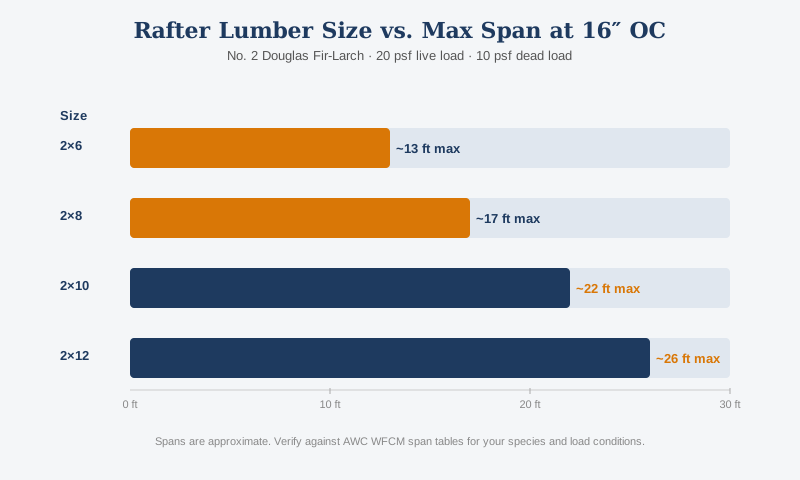
Quick Answer: For most residential roofs at 16" on-center spacing, 2×6 rafters work up to about 13 ft of horizontal span, 2×8 up to 17 ft, 2×10 up to 22 ft, and 2×12 up to 26 ft, but species, grade, and load all shift those numbers.
Why Lumber Size Matters More Than You Think
Choosing the wrong rafter size doesn't just mean a bouncy ceiling. It can mean a roof that sags under a single snow event, or one that an inspector flags before you ever get your certificate of occupancy. The math behind sizing is well-established, the American Wood Council's Wood Frame Construction Manual (WFCM) gives prescriptive span tables that most building departments accept without engineering review.
Once you know your span, pitch, and spacing, you can use our rafter calculator to confirm your rafter length and double-check your numbers before heading to the lumber yard.
Reading a Span Table: The Basics
Span tables look intimidating but they're just a lookup grid. You find your rafter spacing on one axis and your horizontal span on the other, and the table tells you the minimum lumber size that passes under a given load.
The two main variables that shrink or grow your allowable span are:
- Live load: typically 20 psf (pounds per square foot) in low-snow areas, 30 psf or 40 psf where snow piles up
- Dead load: usually 10–15 psf for sheathing, underlayment, and shingles combined
The American Wood Council publishes free span tables at awc.org. Most residential projects use the 20 psf live load / 10 psf dead load table as a starting point, then bump up if the design snow load requires it.
Span Ranges by Lumber Size at 16" OC
These are typical maximums for No. 2 Southern Yellow Pine or Douglas Fir at 16" on-center spacing with a 20 psf live load and 10 psf dead load. Treat them as a planning guide, always verify against your local jurisdiction's adopted code tables.
Switch from 16" OC to 24" OC spacing and those numbers drop by roughly 15–20%. Switch to 12" OC and they increase by about the same margin.
Species Makes a Real Difference
Not all dimensional lumber is the same. Walk into a big-box store in the Pacific Northwest and you'll likely find Douglas Fir-Larch (DF-L). Head to the Southeast and you'll find Southern Yellow Pine (SYP). Drive through the Mountain West and most material is Spruce-Pine-Fir (SPF).
Here's why it matters: Douglas Fir has a modulus of elasticity (E value) around 1.6–1.9 million psi. SPF runs closer to 1.2–1.5 million psi. That difference in stiffness directly affects how much a rafter will deflect under load, and deflection limits (typically L/240 for live load) are what usually control span, not just bending strength.
A 2×10 SPF rafter at 16" OC might max out around 19–20 ft, while the same size in DF-L or SYP can push past 22 ft. Know your species before you finalize your layout.
Visual Grading Marks: What the Stamp Means
Every piece of structural lumber should have a grade stamp from a certified grading agency. Here's what you'll see and what it means:
- Select Structural: highest strength grade; used when spans are tight or loads are high
- No. 1: slightly more knots and defects allowed; good for most roof framing
- No. 2: most common grade sold at lumber yards; works fine for standard spans when species and size are appropriate
- No. 3 / Economy: avoid this for rafters; not suitable for structural applications
The stamp also shows the species group (like "HEM-FIR" or "SYP"), the grading agency (like WWPA or SPIB), and the moisture content ("S-DRY" means 19% or less, which is what you want for framing).
If the stamp is missing or unreadable, don't use that piece for a structural member. It's not worth the risk, and an inspector will likely flag it.
Practical Tips at the Lumber Yard
Check for crowns. Every 2× board has a slight bow, the "crown." Always frame with the crown up on rafters so the load presses it flat rather than amplifying the bow.
Sight down every piece. Pull boards off the stack and look down the length. A twist or warp that looks minor on the ground becomes a headache at the ridge.
Buy 10–15% extra. Culling bad pieces is normal. On a 20-rafter job, plan for 2–3 pieces that won't make the cut.
Ask for "framing-dry" lumber. S-DRY (surfaced dry) is preferable to green lumber, which will shrink and twist as it dries in place and can loosen connections over time.
The rafter length calculator will tell you exactly how long each piece needs to be, including the overhang, so you can spec your order to the correct length and minimize waste.
Engineered Lumber: When to Upgrade
For spans above 24 ft, or when you need to keep floor-to-ceiling height tight, consider LVL (laminated veneer lumber) or I-joist rafters. These products are manufactured to precise E values and won't have the natural defects that limit sawn lumber.
LVL rafters can span 30–40 ft without intermediate support, and they won't crown or twist. The tradeoff is cost, expect to pay 2–3× more per linear foot than dimensional lumber, and the fact that cuts must be made precisely per the manufacturer's spec.
For most residential gable roofs in the 20–28 ft range, however, a well-chosen 2×10 or 2×12 in a quality species and grade will get you there without the added expense.
Tying It All Together
Lumber sizing isn't guesswork. You pick a target span, look up the load conditions, cross-reference the span table for your species and grade, and confirm the size works. The about our calculation methods page explains how our tool handles the geometry side of this equation.
For a deeper look at how calculation errors trip up framers, see 5 common rafter calculation mistakes. And if you're framing a complex roof with hip and valley rafters, hip roof framing basics walks through the extra sizing considerations those members require.
Pick the right lumber the first time and your inspection will go smoothly, and your roof will still be doing its job 40 years from now.
Put it into practice
Get exact rafter lengths in 60 seconds. No signup needed.