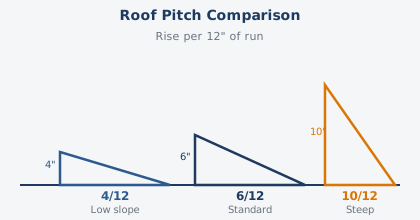
Quick Answer: Roof pitch is the ratio of vertical rise to horizontal run, expressed as X/12. A 6/12 pitch rises 6 inches for every 12 inches of run. Steeper pitches mean longer rafters, more materials, and better drainage, but also more labor cost.
Roof pitch is one of the first decisions in any framing project, and it affects almost everything that comes after, rafter length, material quantities, labor cost, and how your building performs in rain and snow. Getting your head around the numbers before you start saves a lot of recalculation later.
You can use our rafter calculator to see exactly how pitch changes your rafter lengths for any span.
What Pitch Actually Means
Pitch is written as a ratio: rise over run, where run is always 12. So a "6/12" pitch rises 6 inches vertically for every 12 inches of horizontal run.
The full horizontal run is half the building span, from the outside wall to the centerline of the ridge. For a 28 ft wide building, the run is 14 ft (168 inches).
Pitch is different from slope, which is usually expressed as a decimal or percentage (rise ÷ run). A 6/12 pitch equals a 0.5 slope or 50% grade. Most carpenters use pitch notation; engineers often use slope or degrees. All three describe the same thing.
Common Residential Pitches
2/12 to 3/12: Low-Slope
These pitches are nearly flat and require special roofing materials, modified bitumen, TPO, or standing seam metal. Asphalt shingles aren't rated below 4/12 without special underlayment and installation techniques.
Low-slope roofs are common on garages, additions, and modern architectural designs. They're cheaper to frame because the rafters are shorter, but drainage must be carefully designed to avoid ponding water.
4/12: The Minimum for Standard Shingles
The American Wood Council and most roofing manufacturers treat 4/12 as the entry point for standard asphalt shingle applications. It's widely used on ranch-style homes, additions, and any situation where minimizing wall height is a priority.
A 4/12 pitch at 28 ft span gives a run of 168 inches. The rafter multiplier for 4/12 is 1.054, so the structural rafter length (run × multiplier) is approximately 177 inches, or about 14 ft 9 in.
6/12: The Standard Residential Pitch
6/12 is probably the most common pitch in residential construction. It sheds water and snow well, works with virtually every roofing material, and creates a visually balanced roofline. It's steep enough to provide some attic space without excessive wall height.
At 6/12 on a 28 ft wide building, the rafter multiplier is 1.118. The structural rafter length is 168 × 1.118 = 187.8 inches, roughly 15 ft 8 in. That's nearly a full foot longer than the 4/12 rafter on the same building.
8/12: Steep and Dramatic
An 8/12 pitch adds significant attic volume and gives a home a more dramatic appearance. It's also more demanding to build: working on an 8/12 roof requires staging or roof jacks, and material quantities increase noticeably.
The rafter multiplier for 8/12 is 1.202. On a 28 ft building, structural rafter length is 168 × 1.202 = 201.9 inches, about 16 ft 10 in. That's 14 more inches per rafter compared to a 6/12, or roughly 1 extra linear foot of lumber per rafter.
For a garage with 20 rafters, that's 20 extra feet of 2×8 or 2×10, around $40–$80 in lumber depending on current prices, before factoring in any sheathing area increases.
10/12 to 12/12: High-Pitch Applications
Pitches above 8/12 are common in A-frame designs, steep Craftsman homes, and buildings in heavy snow climates where load shedding is critical. At 12/12, the roof is a perfect 45-degree triangle and the rafter multiplier is 1.414.
These pitches are significantly more expensive to frame and require safety precautions that most homeowners aren't equipped for. At 10/12 and above, professional framing crews are worth every dollar.
How Pitch Affects Material Costs
Steeper roofs have a larger surface area than the footprint below them. This is expressed as the roof area multiplier:
The area multiplier tells you how much more sheathing, felt, and shingles you need versus a flat roof of the same footprint. Going from a 4/12 to an 8/12 on a 1,000 sq ft footprint increases your roofing surface from 1,054 sq ft to 1,202 sq ft, about 14% more material.
How to Measure an Existing Pitch
Place a level horizontally on the roof surface. At the 12-inch mark from the lower end of the level, measure straight down to the roof surface. That measurement is your rise, so if it measures 6 inches, you have a 6/12 pitch.
Alternatively, a digital angle finder placed on the roof gives you the angle in degrees. Convert to pitch with: rise = tan(angle) × 12.
Choosing the Right Pitch for Your Build
Snow loads favor steeper pitches. The IRC snow load tables (per ASCE 7-22) show that steeper roofs shed snow faster and accumulate less weight. In zones with ground snow loads above 25 psf, a 6/12 minimum is a reasonable target.
Wind resistance slightly favors lower pitches. Low-slope roofs present less surface area to lateral wind pressure, though the difference is minor in most residential applications. In hurricane zones, the connection details matter far more than the pitch.
Attic space is the biggest lifestyle factor. You need a minimum of 7 ft headroom in 50% of the attic floor area for it to be considered livable space under most codes. At 6/12 on a 28 ft wide building, the ridge height is 7 ft above the plate, barely usable. At 8/12, you get 9 ft 4 in, much more workable.
Roofing material compatibility is a real constraint. The National Roofing Contractors Association and individual shingle manufacturers publish minimum slope requirements. Standard 3-tab asphalt shingles require a 4/12 minimum without special low-slope installation. Architectural shingles carry similar requirements. Metal standing seam can go as low as 1/12 or 2/12. If you're designing to a specific material, check the manufacturer's spec sheet before fixing your pitch.
Pitch and Rafter Spacing
Pitch also affects how far apart your rafters can be spaced. The IRC R802 span tables give maximum allowable spans for common rafter sizes at various pitches and spacings. In general, steeper pitches carry slightly more load per rafter because the snow accumulation factor decreases (ASCE 7-22 roof slope factor Cs). But the table values still set hard limits based on lumber species, grade, and span.
A 2×8 #2 Southern Yellow Pine rafter at 16" OC on a 6/12 pitch can span roughly 14-15 ft depending on your specific design load. The same rafter at 4/12 spans nearly the same distance, pitch has a relatively small effect on span capacity within the residential range. Spacing and lumber size matter more.
Converting Between Pitch, Degrees, and Percent
You'll encounter all three systems depending on context:
- Roofing contractors and carpenters use X/12 pitch notation almost universally
- Structural engineers and architects often use degrees (arctan of rise/run)
- Civil engineers and some product specs use percent grade (rise ÷ run × 100)
Quick reference for common pitches:
Your speed square uses X/12 pitch notation directly. Set it to 6 for a 6/12 pitch, no conversion needed.
Read the rafter cutting guide to see how pitch translates into actual cut angles on the job site, and check our notes on about our calculation methods to understand how we handle ridge board deductions in the rafter length math.
Calculate your rafter dimensions for your chosen pitch to see lumber counts, ridge heights, and birdsmouth specs before you order materials.
Put it into practice
Get exact rafter lengths in 60 seconds. No signup needed.