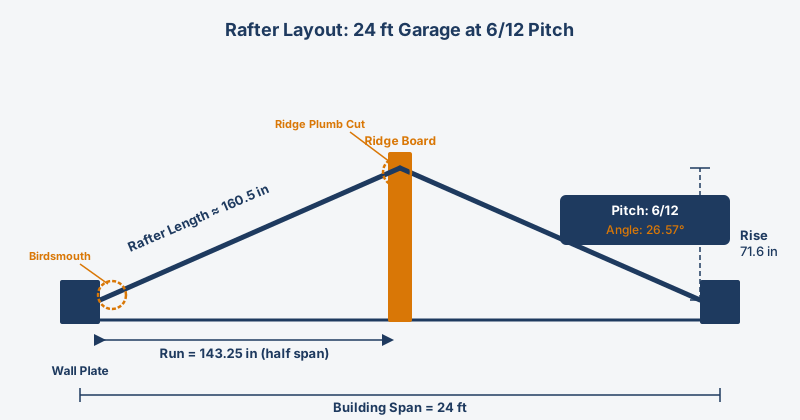
Quick Answer: To cut a rafter, mark the plumb cut at the ridge end using your roof pitch angle, mark the birdsmouth seat cut at the wall plate location, then cut the tail plumb cut at the eave. Always dry-fit one rafter before cutting the full set.
Getting your rafter cuts right the first time saves lumber, time, and a lot of frustration. If you've never cut a rafter before, the process looks intimidating, angles, compound cuts, and terminology that sounds like a foreign language. But once you understand the three cuts involved and how to mark them, it becomes a straightforward layout job.
Before you pick up a saw, use our rafter calculator to get your exact rafter length, plumb cut angle, and birdsmouth dimensions based on your building's span and pitch. Doing the math by hand is prone to errors, especially for beginners.
Tools You'll Need
You don't need a full contractor's kit to cut rafters accurately. Here's the short list:
- Circular saw: a 7-1/4" saw handles any rafter lumber up to 2×10
- Speed square: for marking plumb cuts quickly at any pitch
- Framing square: more precise for laying out the birdsmouth
- Tape measure: 25 ft minimum
- Pencil or chalk line
- Sawhorses: two, set at a comfortable working height
- Safety glasses and hearing protection
A sliding compound miter saw makes repeat cuts faster if you're framing an entire roof, but a circular saw works fine for smaller jobs and gives you more control on the birdsmouth.
Understanding the Three Cuts
Every common rafter has three cuts:
- Ridge plumb cut: the angled cut at the top where the rafter meets the ridge board
- Birdsmouth: the notch that sits over the wall plate (a seat cut + a vertical plumb cut)
- Tail plumb cut: the angled cut at the bottom of the overhang
All three cuts share the same angle, your roof pitch. If you're building at 6/12, every plumb cut on that rafter is at the same 6/12 angle. This is what makes the speed square so useful: set it to your pitch once, and use it for every mark.
Step 1: Calculate Your Rafter Length
For a real example: a 24 ft wide garage with a 6/12 pitch and a 12-inch overhang.
The run (horizontal distance from wall to ridge center) is half the building span, minus half the ridge board thickness. For a 24 ft building with a 1-1/2" ridge board, the run is 143.25 inches (144" − 0.75").
Using the rafter length calculator, this gives a rafter length along the top edge (from plumb cut to birdsmouth plumb cut) of about 160.5 inches, plus 13.4 inches of overhang tail, total rafter stock of roughly 173.9 inches, or just under 14-1/2 feet. Order 16 ft lumber to have enough to work with.
You can verify the geometry yourself: rafter length = run × √(1 + (rise/run)²). For 6/12, the multiplier is 1.118, so 143.25 × 1.118 = 160.1 inches. The calculator accounts for ridge board deduction automatically.
Step 2: Mark the Ridge Plumb Cut
Set your speed square's pivot point at the top corner of the rafter board and rotate it until the "6" on the degree scale (for 6/12 pitch) aligns with the board edge. Draw a line along the blade. That's your plumb cut.
Mark it at the very top end of the board. Cut on the waste side of the line.
The plumb cut angle for a 6/12 pitch is 26.57 degrees from vertical. If you're using a circular saw bevel setting instead of a speed square, set the bevel to 63.43 degrees (90 − 26.57).
Step 3: Measure and Mark the Birdsmouth
From the heel of the plumb cut (the bottom corner), measure along the top edge of the rafter to your calculated rafter length. That point marks the heel of the birdsmouth plumb cut.
Use your framing square or speed square to draw another plumb cut line at that point. Then, from the heel of that line, draw a level (horizontal) line toward the crown of the rafter, this is the seat cut. The seat cut should be exactly as wide as your wall plate depth, typically 3-1/2" for a 2×4 plate or 5-1/2" for a 2×6.
Check your birdsmouth cut guide for details on HAP (Height Above Plate) requirements under IRC R802.7.1, you can't cut the birdsmouth so deep that less than 2/3 of the rafter depth remains above the seat cut.
Step 4: Mark the Tail
From the birdsmouth heel, measure your overhang distance along the top edge, 12 inches for a standard 1-foot overhang, or whatever your plan calls for. Draw a final plumb cut line at that point. That's your tail cut.
For a decorative fascia, you might want a plumb tail. For a level soffit, you'd add a level seat cut at the tail as well. For most standard builds, a simple plumb tail is fine.
Step 5: Cut in the Right Order
Cut the ridge plumb cut first. Then cut the tail plumb cut. Cut the birdsmouth last, it's the most precise cut, so it's better to make it when the board is still its full length and easier to handle.
For the birdsmouth, make the seat cut first, then the plumb cut. Don't try to make both cuts in one pass. Remove the waste piece cleanly, it should fall away without binding if your saw is square.
Step 6: Dry-Fit Before Cutting the Set
Take your first finished rafter and hold it in position against the ridge board and wall plate. It should sit flush, with no rocking or gaps at the birdsmouth. The ridge plumb cut should sit tight against the ridge board face.
If it fits well, use that rafter as your pattern. Trace all three cut lines onto each new board, don't re-measure every rafter individually. Stack the boards crown-up on the sawhorses and transfer the marks, then cut the stack one board at a time.
Common Accuracy Problems
Crowned lumber throws off your layout if you don't account for it. Always install rafters crown-up so the load straightens them over time. You can identify crown by sighting down the length of each board before marking, the high side of the bow should face up.
Dull saw blades cause the blade to wander, especially on the birdsmouth plumb cut. Use a sharp 24-tooth framing blade. A blade that's cut through 200+ feet of lumber is due for replacement.
Inconsistent ridge board thickness on older lumber can shift your plumb cut by up to 1/4". Measure your actual ridge board with a tape, not just the nominal size. A 2× ridge board is nominally 1-1/2" thick, but older or lower-grade stock sometimes runs slightly over.
Moving the pattern rafter between cuts is a surprisingly common error. Clamp your pattern board to the workpiece when tracing, or mark with a permanent marker instead of pencil so the lines don't smudge.
Rafter Spacing and Count
Rafters are typically spaced 16" or 24" on center, per IRC R802.4 rafter span tables. At 16" OC on a 24 ft long garage, you'd need (24 ft × 12 in/ft ÷ 16 in) + 1 = 19 rafters per side, or 38 total plus a doubled end rafter at each gable, roughly 40–42 pieces of stock.
At 24" OC spacing, that drops to about 26–28 rafters total. The wider spacing saves lumber cost but requires a larger rafter size (usually one step up) to maintain the same structural capacity.
The rafter calculator outputs both the rafter count and total linear footage for your dimensions, which you can hand directly to the lumber yard.
After the Cuts: Installation Tips
Before you start nailing, snap chalk lines on the top plate at your rafter spacing so every rafter goes in at the right location. It's much easier to mark the plate before any rafters are in place than to measure from an installed rafter.
Nail each rafter to the ridge board first, two 16d nails face-nailed, or a rafter hanger if the code requires it. Then toe-nail to the wall plate: two 8d nails on each side. Install the hurricane ties after the toe-nails are set. Collar ties or ceiling joists get nailed in on the way up, not after everything is set.
For a complete set of dimensions before you start, calculate your rafter dimensions with your exact span and pitch. Having the numbers in hand before you touch the lumber makes the whole job go faster.
See also: Roof Pitch Explained for how pitch affects your rafter length calculations, and Birdsmouth Cut Guide for the detailed seat cut layout. Learn about our calculation methods if you want to understand how the rafter length formula works.
Put it into practice
Get exact rafter lengths in 60 seconds. No signup needed.