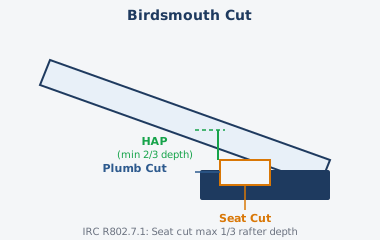
Quick Answer: The birdsmouth is the notch cut into a rafter that lets it sit over the wall plate. It has two parts: a plumb cut (vertical) and a seat cut (horizontal). Under IRC R802.7.1, the remaining rafter depth above the seat cut must be at least 2/3 of the full rafter depth.
The birdsmouth is a small cut with a big job. It's the only thing anchoring each rafter to the wall below it, so getting the depth and angle right matters. Cut it too shallow and the rafter won't sit flat. Cut it too deep and you've violated code, and weakened the rafter.
Before marking any cuts, use our rafter calculator to get your birdsmouth seat cut depth and plumb cut position for your specific pitch and lumber size. Doing this by hand is fine once you understand the geometry, but having a reference number prevents costly mistakes.
What the Birdsmouth Is
The birdsmouth (sometimes called a "bird's mouth" or "seat cut") is a triangular notch at the bottom of a rafter that straddles the wall plate. It consists of:
- Seat cut: a horizontal cut that bears on top of the wall plate
- Plumb cut: a vertical cut that aligns with the face of the wall plate
Together they create an L-shaped notch. When the rafter is installed, the seat cut sits flat on the plate, and the plumb cut drops down along (or clears) the outer face of the wall.
The depth of the seat cut determines how much rafter depth remains above the plate. This remaining depth is called the HAP: Height Above Plate.
The IRC R802.7.1 HAP Requirement
Section R802.7.1 of the International Residential Code states that the notch depth at the birdsmouth shall not exceed one-third of the rafter depth. That means the Height Above Plate must be at least two-thirds of the full rafter depth.
For a 2×8 rafter (actual depth: 7-1/4 inches):
- Maximum notch depth: 7.25 ÷ 3 = 2.42 inches
- Minimum HAP: 7.25 × (2/3) = 4.83 inches
For a 2×6 rafter (actual depth: 5-1/2 inches):
- Maximum notch depth: 5.5 ÷ 3 = 1.83 inches
- Minimum HAP: 5.5 × (2/3) = 3.67 inches
These are absolute maximums. If your wall plate is 3-1/2 inches wide and your pitch is steep, you might find that keeping HAP at or above the minimum means your seat cut doesn't fully contact the plate. In that case, the rafter lumber size needs to go up.
How Pitch Affects Birdsmouth Depth
At a low pitch like 4/12, the rafter runs nearly horizontally, so the angle between the seat cut and the rafter edge is shallow. A small seat cut depth gives you a generous bearing area on the plate.
At steeper pitches, 8/12 or higher, the rafter drops away from the plate more steeply, and the geometry changes. The seat cut has to be deeper to achieve the same plate bearing width, which eats into your HAP faster.
For a 2×8 at 6/12 pitch targeting a 3-1/2 inch bearing on a 2×4 plate, the seat cut depth is approximately 1.75 inches. That leaves 7.25 − 1.75 = 5.5 inches of HAP, well above the 4.83-inch minimum.
At 8/12 pitch with the same 2×8 and 3-1/2 inch plate bearing, the required seat cut depth increases to about 2.33 inches, leaving 7.25 − 2.33 = 4.92 inches of HAP. Still code-compliant, but with only 0.09 inches of margin. Go to a wider plate (2×6) and the math changes again.
This is exactly why you should calculate your rafter dimensions before you start, the calculator shows you whether your chosen lumber size gives you legal HAP at your pitch.
How to Mark the Birdsmouth
Using a Speed Square
Set your speed square to your pitch. For 6/12, find the "6" on the degree scale. Place the pivot point of the square against the rafter edge and rotate until the scale reads your pitch number. Draw a line along the blade. That's your plumb cut line.
Now slide the square so the body (the part with the pivot hole) is sitting flat on the top edge of the rafter, with the plumb cut line still where you want the heel of the birdsmouth. From the heel of the plumb cut line, draw a horizontal line toward the ridge. That's your seat cut line.
Mark the seat cut depth (in our 2×8 example, 1.75 inches from the top edge) and draw a parallel line to the rafter's top edge. Where that line intersects your seat cut line is the deepest point of the notch.
Using a Framing Square
A framing square gives slightly more precision on larger lumber. Hold the square so the blade shows your rise number on one arm and 12 on the other arm, both touching the top edge of the rafter simultaneously. Draw along both arms, that marks both cuts in one step.
Cutting the Birdsmouth
Use a circular saw to make the seat cut first. Set your bevel to 0 (square to the blade) and cut along the seat cut line, stopping exactly at the intersection with the plumb cut line. Don't overshoot, cutting past the intersection weakens the rafter regardless of your HAP number.
Make the plumb cut second, again stopping exactly at the intersection. The waste triangle should fall away cleanly.
Clean up the corner with a sharp chisel if the saw kerf leaves any material in the corner. The seat cut surface must sit flat and fully bear on the wall plate, any high spots will rock the rafter.
Common Mistakes
Cutting past the intersection. Even a 1/4" overcut creates a stress concentration point. Take the cut slowly and stop at the line.
Not accounting for actual vs. nominal lumber dimensions. A 2×8 is 7-1/4" deep, not 8". All your HAP calculations must use actual dimensions.
Inconsistent seat cut depths across the set. If your birdsmouth depth varies by even 1/4" from rafter to rafter, your ridge will have a wavy appearance. Use a pattern rafter and trace all birdsmouths from it, don't re-measure each one individually.
Ignoring plate width on angled walls. For walls that aren't perpendicular to the rafters (like on a hip roof), the seat cut bearing width changes. Check the hip roof framing guide for those cases.
Misreading crown direction. If you lay out the birdsmouth on the wrong face of a crowned board, the rafter will sit cock-eyed on the plate. Always sight down the board for crown before you start marking, and consistently put the crown side up.
HAP and Rafter Size Selection
If you're still in the planning stage and haven't ordered lumber yet, checking HAP before you commit to a rafter size is worth 10 minutes of calculation. Here's how to work through it:
- Decide on your wall plate size (2×4 = 3-1/2" wide, 2×6 = 5-1/2" wide)
- Calculate the required seat cut depth: seat depth = plate width × sin(pitch angle). For a 3-1/2" plate at 6/12 (26.57°): 3.5 × sin(26.57°) = 3.5 × 0.447 = 1.57 inches
- Calculate minimum required rafter depth: depth = seat depth × 3 (since seat depth ≤ 1/3 of total). So 1.57 × 3 = 4.71 inches. A 2×6 (5-1/2" actual) clears this; a 2×4 (3-1/2") doesn't.
For a 2×6 plate at 8/12 (33.69°): seat depth = 5.5 × sin(33.69°) = 5.5 × 0.555 = 3.05 inches. Minimum rafter depth = 3.05 × 3 = 9.14 inches. That means a 2×10 (9-1/4") barely works, and a 2×8 (7-1/4") doesn't, not because of span capacity, but because of HAP alone. This is a real design constraint that catches builders by surprise.
The rafter calculator checks HAP automatically when you enter your plate size, rafter size, and pitch. If the combination doesn't meet the IRC minimum, it will flag it before you cut anything.
Checking Your Work
After cutting the birdsmouth on your pattern rafter, test it against a scrap of wall plate material before cutting the full set. The seat cut should lie completely flat, use a straightedge to check for any rocking. The plumb cut face should be plumb when the rafter is in its installed position.
Measure the HAP directly on your cut board: it's the vertical distance from the seat cut surface to the top edge of the rafter, measured at the plumb cut line. For a 2×8 at 6/12, you should see 5.5 inches. If it's significantly less than 4.83 inches, re-cut from fresh stock.
For more context on how the birdsmouth fits into the full layout process, read the rafter cutting guide. And to understand how pitch changes the angles involved, the roof pitch guide covers the geometry behind the numbers.
Learn more about about our calculation methods and how HAP is computed in our rafter calculator.
Put it into practice
Get exact rafter lengths in 60 seconds. No signup needed.