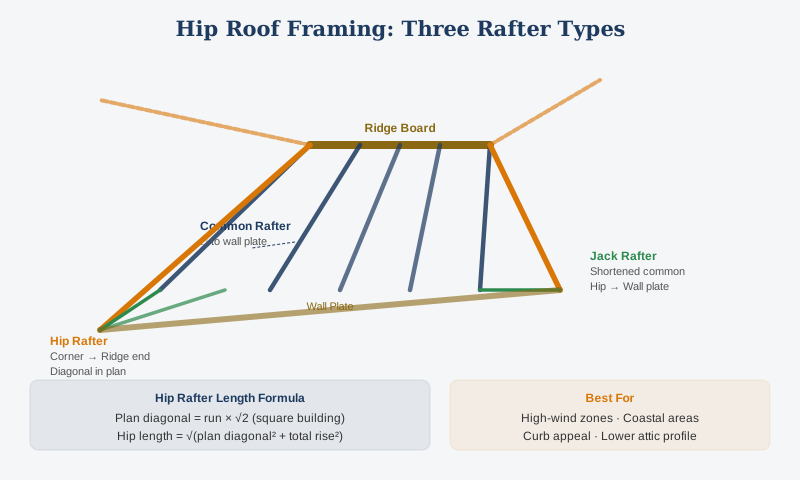
Quick Answer: A hip roof has sloped ends in addition to sloped sides, requiring hip rafters running diagonally from the corners to the ridge, jack rafters filling in between, and sometimes valley rafters where rooflines meet. Common rafters in the body of a hip roof are calculated the same way as a gable roof, use our rafter calculator for those.
A gable roof is a triangle viewed from the end. A hip roof is a truncated pyramid, four sloped planes that all meet at or near the ridge. The trade-offs are real in both directions: hip roofs are more wind-resistant, require no gable-end walls, and often look more finished. They're also significantly more complex to frame.
The Three Rafter Types in a Hip Roof
Common rafters form the bulk of the roof's framing, they run perpendicular from the ridge board to the wall plate, just like in a gable roof. On a hip roof, the common rafters occupy the central rectangular portion of each slope. You calculate their length, birdsmouth, and HAP exactly the same way as a gable roof. Calculate your common rafter dimensions before touching a saw, the geometry is identical regardless of whether the roof ends are gabled or hipped.
Hip rafters run diagonally from each corner of the building up to the end of the ridge. They're always longer than the common rafters because they travel a diagonal distance across the plan and also rise vertically. The run of a hip rafter is the diagonal of the building's half-width and half-length, for a 28×40 building at half-span 14 feet, the hip rafter run is √(14² + 14²) = 19.8 feet on a square hip, adjusted for the ridge length on rectangular buildings. The hip rafter length then follows the same Pythagorean relationship, using the hip run and the same unit rise as the common rafters.
Jack rafters are shortened common rafters that connect the hip rafter to the wall plate. They decrease in length as they approach the corner. On most residential hip roofs at 16-inch OC, jacks are evenly spaced and decrease by a constant "common difference", the length reduction between adjacent jacks. That common difference equals the rafter spacing (16 inches) multiplied by the pitch factor (rise per inch of run). At 6/12 pitch, the common difference for 16-inch OC jacks is 16 × 0.5 = 8 inches per rafter.
Hip vs. Ridge Connection
On a hip roof, the ridge board is shorter than the building length, it terminates where the hip rafters converge. The ridge length equals the building length minus the building width (for a square hip). On a 28×40 building, the ridge is 40 − 28 = 12 feet long. Both hip rafters frame into each end of that ridge, and the jacks fill the triangular sections on each side.
Getting the ridge height right is critical. The ridge board sits at the same height as it would on a gable roof of the same pitch, calculated from the common rafter rise. Our rafter calculator gives you the ridge height for a given span and pitch, which applies directly to the hip roof's common rafter section.
Valley Rafters
When two roof sections intersect, a porch roof meeting the main house, or an ell addition meeting the original roofline, you get a valley. A valley rafter runs from the exterior corner (where the walls meet) up to the ridge at a diagonal, sloping downward from the ridge rather than upward like a hip rafter. The geometry is the mirror image of a hip: the valley run is also a diagonal of the plan dimensions, and valley jacks decrease in length as they approach the valley instead of the corner.
Valleys are notorious leak points and must be flashed carefully. The structural framing is straightforward once you understand hip rafters, valley geometry is directly analogous.
When Hip Roofs Make Sense
Hip roofs are standard in high-wind regions (Gulf Coast, coastal areas, tornado zones) because eliminating gable-end walls removes the largest wind load surface on a residential structure. FEMA wind zone recommendations and Florida's building code both reflect this, hurricane strapping requirements are less onerous on hip roofs in many wind exposure categories.
From an aesthetic standpoint, hip roofs give a lower, more horizontal profile that suits certain architectural styles (craftsman, ranch, colonial). The absence of gable overhangs reduces long-term maintenance and the risk of wind-driven rain infiltration at the gable ends.
The trade-off is attic access and usable space. A hip roof's attic has steeply sloped surfaces on all four sides, making floor-level usable space smaller than a gable roof with the same footprint. If attic storage or a finished bonus room is a priority, the gable wins, see our rafters vs. trusses comparison for how attic space factors into framing decisions.
Calculating a Hip Roof
Start with the common rafters, our rafter length calculator handles those. Enter your building span, pitch, and overhang to get the common rafter cut list. From there, calculate hip rafter run as the diagonal of your half-span dimensions, apply the same unit rise, and compute the hypotenuse. Jack rafter common differences follow directly from the spacing and pitch.
If you're framing a hip roof for the first time, strongly consider hiring a framer for the layout and the first few courses, then finishing the work yourself. Hip layout is where most first-timers lose time, the geometry is straightforward on paper and confusing at full scale on a building. See our DIY roof framing guide for an honest assessment of where to draw the do-it-yourself line. Learn about our calculation methods for the full methodology.
Put it into practice
Get exact rafter lengths in 60 seconds. No signup needed.