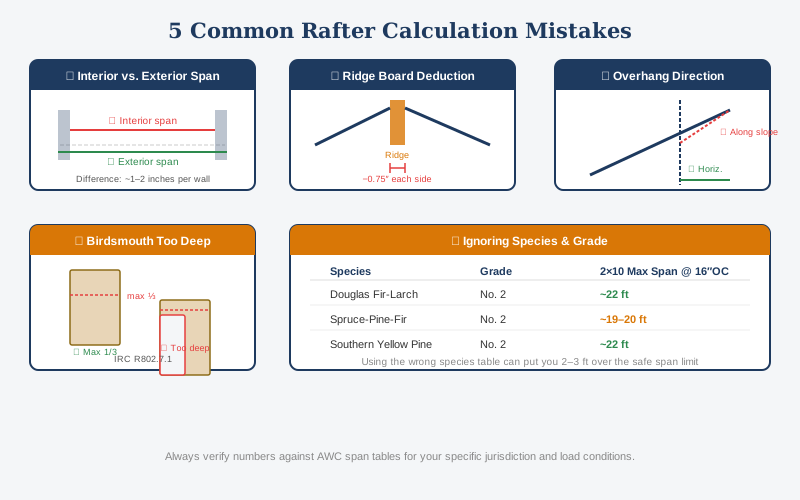
Quick Answer: The most common rafter calculation mistakes are measuring the interior span instead of exterior, forgetting the ridge board deduction, measuring overhang along the slope instead of horizontal, cutting the birdsmouth too deep, and ignoring how species and grade affect allowable spans.
Rafter math looks simple until you're standing on a ladder holding a piece of lumber that's 2 inches too short. Most framing errors aren't complex. They're repeatable mistakes that happen when you rush through the setup math. Getting it right once at the calculator saves you from getting it wrong three times at the saw.
Use our rafter calculator to run through your numbers before you cut a single board. Then check your inputs against these five mistakes.
Mistake 1: Measuring the Interior Span Instead of Exterior
This one trips up a lot of first-time framers. The rafter span, the number that goes into your span table lookup and your rafter length formula, is the exterior wall-to-wall distance, not the interior room width.
The problem in practice: Suppose your house measures 24 ft between interior faces of the stud walls. If your walls are framed with 2×6 studs and have 5/8" sheathing on each side, the exterior dimension is closer to 25 ft 5 in. Use 24 ft and your ridge lands in the wrong place; your pre-cut rafters end up short on the seat cut end.
The fix: Always measure from outside face of top plate to outside face of top plate. That's the number that drives rafter length. If you're working from architectural plans, look for the "out-to-out" dimension, not the clear span.
Mistake 2: Forgetting the Ridge Board Deduction
The ridge board sits between the opposing rafters, which means each rafter doesn't actually reach the centerline of the building, it stops at the side face of the ridge board.
The problem in practice: A standard 2× ridge board is 1.5" thick. That means each rafter gets shortened by half of 1.5", which is 0.75", measured horizontally, not along the rafter slope. On a 6/12 pitch, 0.75" of horizontal run translates to about 0.94" of rafter length. Use the un-adjusted number and both rafters will be nearly an inch long, which creates a gap or a forced bow at the ridge.
The fix: Subtract half the ridge board thickness from the run before calculating rafter length. For a 1.5" ridge board: run adjusted = (span / 2) − 0.75". Our rafter length calculator applies this deduction automatically when you enter your ridge board thickness.
Mistake 3: Measuring Overhang Along the Rafter Instead of Horizontal
Roof overhangs are specified as horizontal distances on construction drawings, the amount the fascia projects beyond the exterior wall face. But framers sometimes measure the overhang along the slope of the rafter, which produces a shorter horizontal projection than intended.
The problem in practice: On a 6/12 pitch, if you measure 18" along the rafter slope from the wall plate, the actual horizontal projection is only about 16.1". Over the life of the roof, this means gutters that don't clear the wall adequately and water that drips closer to the foundation than planned.
The fix: Always convert overhang specs to horizontal measurement first. Horizontal overhang = overhang along slope × cos(roof pitch angle). For a 6/12 pitch (26.57°), that cosine factor is about 0.894. Or just enter your desired horizontal overhang directly into a rafter calculator, no trigonometry required.
Mistake 4: Cutting the Birdsmouth Too Deep and Violating HAP Rules
The birdsmouth is the notch cut into the rafter where it seats on the top plate. Cut it too deep and you've violated IRC R802.7.1, which limits the notch depth to no more than one-third of the rafter's total depth.
The problem in practice: On a 2×8 rafter (actual depth 7.25"), the maximum seat cut depth is 7.25 / 3 = 2.42". If you're framing a steeper pitch, say 9/12 or 12/12, and you want a full 3.5" bearing on the top plate, the geometry can force you to cut deeper than that limit. Framers who just "make it work" without checking the HAP (Height Above Plate) end up weakening the rafter at its most stressed point.
The fix: Calculate your HAP before cutting. HAP = rafter actual depth − seat cut depth. Verify that the seat cut depth stays at or below 1/3 of the rafter's actual depth. If the geometry forces a deeper cut, you have two options: go up a rafter size (2×10 instead of 2×8) or reduce the wall plate width. For detailed guidance on this cut, see our birdsmouth cut guide.
Mistake 5: Ignoring Species and Grade in Span Calculations
Picking a rafter size from a span table without knowing your lumber species and grade is like guessing your tire pressure. The table tells you the answer for a specific set of material properties, and "2×10" doesn't mean the same thing if it's Select Structural Douglas Fir versus No. 3 Spruce-Pine-Fir.
The problem in practice: A 2×10 No. 2 Douglas Fir-Larch rafter at 16" OC can span roughly 22 ft under a standard 20 psf live / 10 psf dead load. A 2×10 No. 2 SPF rafter at the same spacing maxes out closer to 19–20 ft. Use the DF-L table when your yard is supplying SPF, and you've got rafters that don't technically meet code even though they're the "right size."
The fix: Check your lumber stamp before you start calculating. Confirm the species group, the grade, and the moisture content. Then look up that specific combination in the American Wood Council WFCM span tables or your local code-adopted equivalent. Our lumber sizing guide walks through exactly how to read a grade stamp and map it to the right table.
A Final Note on Checking Your Work
Each of these mistakes is easiest to catch before you've committed to a layout. Run your numbers through the calculate your rafter dimensions tool, then walk through this checklist:
- Did I use exterior span (outside plate to outside plate)?
- Did I subtract half the ridge board thickness from the run?
- Is my overhang spec a horizontal measurement?
- Does my planned birdsmouth seat cut stay at or below 1/3 of rafter depth?
- Do my span table numbers match my actual lumber species and grade?
Answer yes to all five and you can cut with confidence. For the code-specific rules that govern items 4 and 5, the IRC roof framing requirements post has the exact section references you'll need if an inspector asks.
Put it into practice
Get exact rafter lengths in 60 seconds. No signup needed.