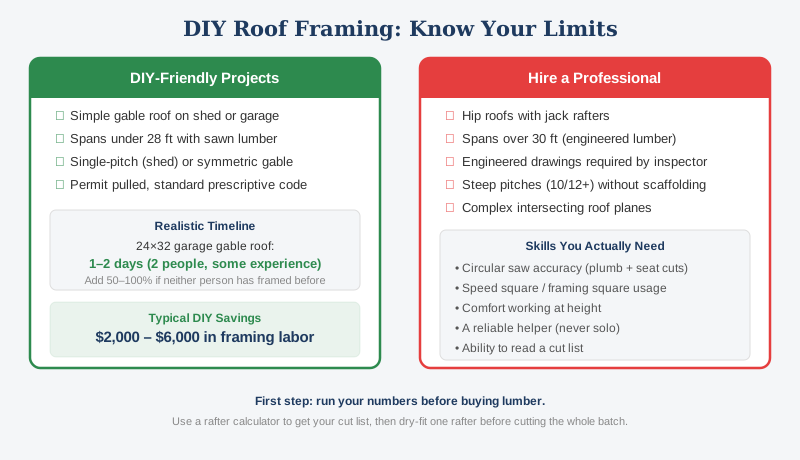
Quick Answer: A straightforward gable roof on a garage or shed is genuinely DIY-able if you can read a tape measure, operate a circular saw, and follow a cut list. Complex hip roofs, spans over 30 feet, or any project requiring engineered drawings should involve a professional framer or structural engineer.
Roof framing has a reputation for being beyond the DIY realm. That reputation is half-deserved. The geometry can be confusing if you've never worked through it before, and working at height with heavy lumber introduces real safety stakes. But for a standard gable roof on a garage, shed, or small addition, the actual skill requirement is lower than most people assume. The math is the hard part, and that's what calculators are for.
What You Actually Need to Know
The core skill for stick framing a roof is accurate layout and cutting. You need to be able to:
- Read a tape measure to 1/16 inch
- Operate a circular saw for plumb cuts and seat cuts
- Use a speed square or framing square to mark angles
- Understand how to read a cut list
- Work safely on a ladder and temporary scaffolding
You don't need to be able to derive the Pythagorean theorem. You need to enter your building dimensions into the rafter calculator and get a cut list. From there, it's execution, cutting accurately, dry-fitting one rafter before you commit to cutting 20 more, and nailing with the right schedule.
Realistic Timeline
A two-person crew with basic framing experience (one of them has done it before) can frame a standard 24×32 gable garage roof in 1–2 days. That includes: setting the ridge board, cutting and installing all common rafters, installing blocking and collar ties, and cutting the fascia tail length.
If neither person has framed a roof before, add 50–100% to that estimate. The first rafter always takes longer. The second goes faster. By rafter 10 you've found your rhythm.
A 28×40 house roof is a 2–3 day job for the same crew, more material volume, more running cuts, same fundamental process.
The Permit Question
Pull a permit. For new construction or any structural addition, most jurisdictions require one for roof framing. The permit fee ($300–$1,500 depending on project value and jurisdiction) buys you a framing inspection, which is your catch-net for anything you got wrong. An inspector catching an overcut birdsmouth before the sheathing goes on saves you from tearing it out yourself later.
DIY framing with a permit is legal and common. Unpermitted structural work creates problems at resale, can void homeowner's insurance for related claims, and leaves you personally liable if something fails. Don't skip it.
Where to Hire Out
Some parts of roof framing aren't worth doing yourself. Complex hip roofs require three different rafter types (common, hip, and jack), and the layout requires either significant experience or an engineer's drawing. If you've never laid out a hip end, a 24×36 garage hip end will take you two days of head-scratching. A framer who's done it 100 times will finish it in a few hours. See our hip roof framing guide for what's involved.
Spans over 30 feet start to require engineered lumber (LVL or parallel strand lumber) or structural ridge beams sized by an engineer. If your building inspector is going to ask for a stamp, get one, hiring an engineer for a few hundred dollars in review time is cheaper than failing an inspection and redesigning on the fly.
Any jurisdiction requiring engineered drawings means you need a licensed professional of record before the permit is even issued. Commercial construction almost always falls into this category; some residential jurisdictions do too for larger spans.
Cost Savings of DIY
The labor cost to hire a framing crew for a 24×32 garage roof runs $2,000–$4,500 depending on location and pitch complexity. Materials for the same roof (2×6 or 2×8 rafters, ridge board, blocking, hardware) run $800–$1,500. If you can frame it yourself in a weekend with a helper, you keep $2,000–$4,500 in your pocket.
That's a meaningful number. But it only pencils out if your time is actually free and your work passes inspection. A failed framing inspection that requires rework eats into those savings quickly.
Getting Your Numbers Right First
Before you buy lumber or touch a saw, run your numbers through the rafter length calculator. Enter your building span, pitch, eave overhang, and lumber size. The calculator gives you exact rafter length, birdsmouth dimensions, and board count. Cut your first rafter from those numbers, dry-fit it to the ridge and plate, verify the HAP measurement, and confirm it sits flush.
Once that test rafter fits, it becomes your pattern. Trace every subsequent rafter from it, don't re-measure from scratch each time. For cutting technique, see our step-by-step rafter cutting guide. For the building code requirements your inspector will check, see our IRC roof framing requirements guide. Have a question about how the calculations work? The methodology page explains the geometry.
Put it into practice
Get exact rafter lengths in 60 seconds. No signup needed.