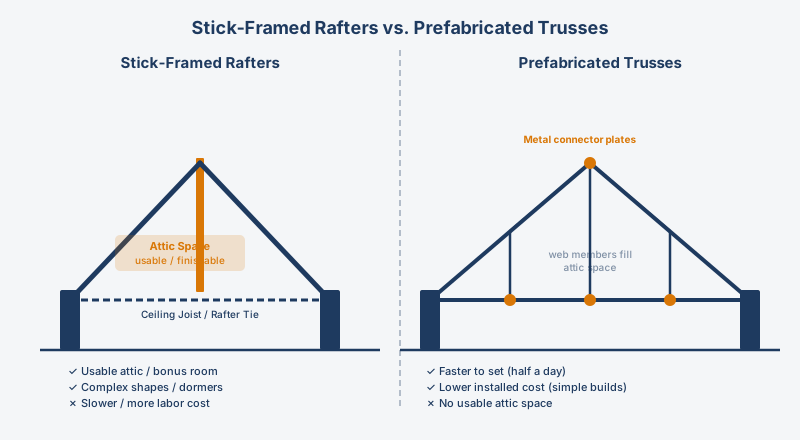
Quick Answer: Trusses are faster and usually cheaper to install on simple rectangular buildings. Stick-framed rafters are the better choice when you want finished attic space, have a complex roof shape, or are doing most of the work yourself.
If you're planning a new roof and not sure whether to go with traditional cut rafters or engineered trusses, you're facing one of the most practical decisions in residential framing. Both systems work, but they're optimized for different situations, and choosing the wrong one can cost you real money or living space.
What Stick-Framed Rafters Are
Stick framing means cutting and installing each rafter individually on-site. A carpenter lays out the plumb cut at the ridge, notches a birdsmouth at the wall plate, and nails each piece in place one at a time. The geometry is entirely within your control.
The rafter calculator handles the math, span, pitch, overhang, and lumber size all feed into exact cut dimensions. Once you have the numbers, the actual framing is a repetitive layout-and-cut process that a capable DIYer can handle on a modest project.
The main advantage of stick framing is flexibility. You can frame dormers, vaulted ceilings, irregular spans, and intersecting rooflines that would require expensive custom engineering if done in trusses. If you want a livable attic or a bonus room above the garage, cut rafters are your path to getting there.
What Prefabricated Trusses Are
Trusses are factory-built triangulated assemblies engineered to span your building's full width in one piece. They arrive on a flatbed truck and a crane or small crew sets the full roof structure in hours.
A standard Fink (or "W") truss uses diagonal web members that fill the interior of the triangle. Those webs make the truss structurally efficient, but they also mean there's no usable space inside the attic. Every bit of open air between the top and bottom chords is occupied by 2×4 lumber in a zigzag pattern.
Trusses are engineered products. The truss manufacturer submits stamped drawings for your specific span, pitch, and load conditions. That engineering is already done for you, which removes one layer of complexity from the project, but it also means lead times of 2–6 weeks from order to delivery.
Cost Comparison
Trusses typically run $30–$60 per truss installed in most US markets, including delivery. For a 40-foot long house with trusses at 24-inch on-center spacing, you'd need about 21 trusses, call it $630–$1,260 in truss cost. Add crane rental ($400–$800 for a half-day) and a small setting crew (4 hours × 4 people at $35/hr = $560), plus hardware, and total installed cost lands around $2,000–$3,000.
Stick framing the same building costs less in materials but far more in labor. Framing labor for a standard gable roof runs $3.50–$5.50 per square foot of roof surface area. A 28×40 building at 6/12 pitch has about 2,530 sq ft of roof surface. At $4.50/sq ft, that's $11,385 in labor, plus $1,500–$2,000 in lumber and hardware. Total: $12,000–$14,000 with a hired crew.
On a simple rectangular building with a hired crew, trusses can save $8,000–$10,000. That gap narrows significantly for complex roofs, and it disappears entirely if you're providing your own labor.
Structural Differences
Both systems handle standard residential loads when properly designed and installed. The key difference is load path.
A truss is a self-contained structural unit. The bottom chord acts simultaneously as a ceiling joist and a rafter tie, so the triangulated system resists outward thrust internally. You don't need separate collar ties or a structural ridge beam.
Stick rafters push outward on the walls under load. IRC R802.4 requires rafter ties or collar ties for any rafter span over 8 feet. Skip them and the walls can spread over time, a documented failure mode in older additions and farm buildings. The American Wood Council's Span Tables for Joists and Rafters governs minimum sizing and connection requirements for cut-rafter systems.
When Stick Framing Makes More Sense
You want finished attic space. This is the dominant reason people choose cut rafters over trusses. Standard trusses are completely incompatible with livable attic space. If you want a bonus room, home office, or even decent storage, you need either stick-framed rafters or a specialty attic truss, which costs 2–3× more than a standard Fink truss and still has less usable volume than a stick-framed attic.
The roof has multiple intersecting planes. Valleys, dormers, hips, and irregular setbacks are hard to truss economically. Each non-standard section requires custom engineering and factory production time. For complex roof designs, many framers find it more practical to stick-frame the entire thing rather than coordinate a mix of standard trusses, custom trusses, and fill framing.
You're doing the work yourself. Trusses arrive on a flatbed and require a crane or boom truck. A single truss for a 28-foot building weighs 150–250 pounds and is too unwieldy to hand-lift safely. Cut rafters are manageable with two or three people and basic scaffolding. For a garage, barn, or addition where owner labor is the plan, cut rafters are almost always more practical.
Lead time is an issue. Truss manufacturers typically need 2–6 weeks from order to delivery. If your schedule is tight or your dimensions might change, stick framing lets you start the same day you buy lumber and adapt mid-project without repricing.
When Trusses Make More Sense
Simple rectangular buildings with no attic plans. Detached garages, storage buildings, workshops, and spec homes where attic space isn't part of the program are ideal truss candidates. The installation is fast, the engineering is already stamped, and the total cost is significantly lower than stick framing.
Long clear spans. Trusses can span 40, 60, or even 80 feet without intermediate bearing walls. Stick-framed rafters over a 40-foot span require substantial lumber, 2×12s or engineered LVL, plus a structural ridge beam and support posts. Trusses handle wide spans cleanly without those complications.
Commercial-scale production. On large subdivisions with dozens of identical floor plans, trusses let a small crew put the roof on in a single day. The consistency and speed are impossible to match with stick framing.
DIY Considerations
Cutting rafters is a genuinely achievable task for a patient beginner on a modest-scale project. You need to understand plumb cuts, birdsmouth layout, and how to read the rafter length calculator output. The rafter cutting guide walks through the entire process step by step.
Setting trusses yourself is a different matter. The weight and awkwardness of handling full-span trusses makes it genuinely risky without a crane or a larger crew. If you go with trusses and want to save money, you can be part of the setting crew, but budget for crane rental regardless.
Making the Decision
For most homeowners hiring a crew on a standard gable-roof building, trusses win on cost. For owner-builders, anyone who wants a finished attic, and anyone dealing with a complex roof shape, stick framing wins on flexibility.
Calculate your rafter dimensions before you finalize the decision, seeing the actual lumber counts and lengths for your project makes the cost comparison much more concrete. Also see about our calculation methods for how rafter length and birdsmouth specs are computed.
For more on stick-framing costs, see the roof framing cost breakdown.
Put it into practice
Get exact rafter lengths in 60 seconds. No signup needed.