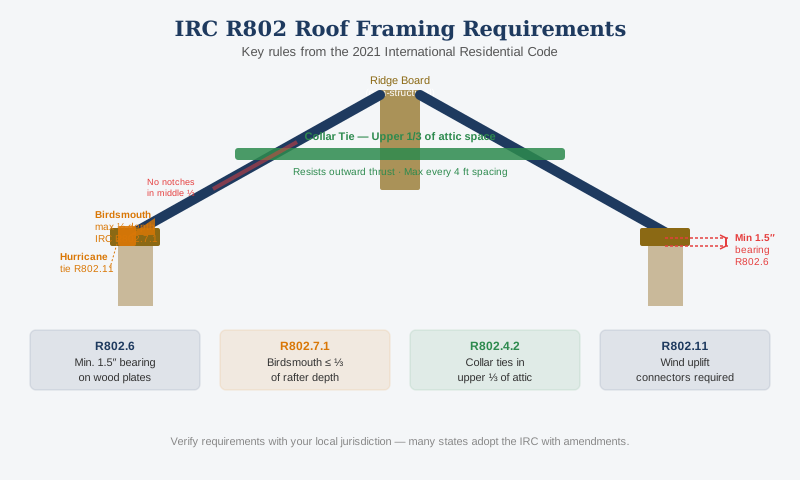
Quick Answer: Under IRC 2021 Section R802, rafters need at least 1.5 inches of bearing on plates, birdsmouth seat cuts can't exceed 1/3 of the rafter depth, and spans over 8 feet need collar ties at the upper third. Most jurisdictions have adopted IRC 2021 or 2018, always confirm with your local building department.
Building codes for roof framing aren't bureaucratic hurdles. They're load calculations someone already did for you. The IRC's R802 requirements reflect decades of failure data, buildings where rafters spread walls, ridge boards sagged, or connections pulled apart. Following them is the fastest way to frame a roof that won't give you problems in 20 years.
Which Code Applies to Your Project?
Most US states have adopted the International Residential Code (IRC) 2021 or are within one or two cycles of it. A few states, notably California, Florida, and New York, maintain their own amendments layered on top of the IRC. Your local building department can tell you exactly which edition is in force and what amendments apply.
Pulling a permit is non-negotiable for new construction and most additions. The permit triggers a framing inspection, which is your safety net. An inspector catching a problem before sheathing goes on saves you from tearing it out later.
Minimum Bearing (Section R802.6)
Rafters must bear on wall plates or ridge boards with a minimum of 1-1/2 inches of bearing surface. That means the seat cut of the birdsmouth needs to sit fully on the plate, not cantilevered off the edge, not clipped short by a deep notch. In practice, a properly sized birdsmouth on the correct lumber size almost always achieves this automatically. The rafter calculator checks your birdsmouth dimensions and will flag cases where bearing could be marginal.
Birdsmouth Depth Limits (Section R802.7.1)
This is the one that catches DIYers most often. The seat cut depth of the birdsmouth, measured from the back of the rafter to the bottom of the notch, cannot exceed 1/3 of the rafter depth. On a 2×8 (actual depth 7.25 inches), the maximum birdsmouth seat cut is 2.42 inches.
Exceed that and you've violated the HAP requirement. HAP (Height Above Plate) is the rafter depth remaining above the birdsmouth, and it must stay at least 2/3 of the total rafter depth. A deeper notch weakens the rafter at exactly the point where bending stress is highest.
Steep pitches (10/12, 12/12) create deeper birdsmouth requirements geometrically. At some point, you need to upsize your lumber to keep the birdsmouth within limits, or accept a smaller overhang that reduces the required notch depth. The calculator handles this automatically and warns you when HAP is at risk.
Collar Ties vs. Ridge Beams (Section R802.4 and R802.3)
Rafters want to push the walls outward. The classic solution is ceiling joists that tie the two walls together like the base of a triangle. When you don't have ceiling joists (vaulted ceilings, for instance), you need either collar ties or a structural ridge beam.
Collar ties work when: they're installed at the upper 1/3 of the attic space, they connect opposing rafters, they're spaced no more than 4 feet apart (or at every rafter pair for lighter loads), and they're sized per the IRC span tables (minimum 1×4 for most residential applications). They're not a substitute for ceiling joists over the full span. They just prevent the top of the roof from spreading.
A structural ridge beam carries the roof load vertically to posts, eliminating horizontal thrust entirely. This is the right choice for fully vaulted ceilings. Sizing a ridge beam requires engineering, it's not covered by the prescriptive tables in Chapter 8.
Notch and Hole Rules (Section R802.7)
You cannot cut notches in the middle third of a rafter span. Notches at the ends (the birdsmouth and plumb cut) are fine within the limits above. Holes must be at least 2 inches from any edge and can't exceed 1/3 of the rafter depth. These rules exist because the middle of a rafter's span is where bending stress peaks, removing material there creates a stress concentration.
Wind Uplift Connectors (R802.11)
In high-wind zones (ASCE 7 wind exposure categories C and D, or anywhere with design wind speeds above 90 mph), you need hurricane ties or rafter ties at every rafter connection. These metal connectors are cheap insurance and easy to install before sheathing goes on. Check FEMA's wind zone maps, more of the country falls into high-wind requirements than most builders realize.
What Inspectors Actually Check
A framing inspector on a roof will typically verify: rafter species and grade marks, bearing at the plate, birdsmouth depth on a few sample rafters, collar tie or ridge beam presence, nailing schedule at the ridge and plate connections, and wind uplift hardware. They're not going to measure every rafter to the millimeter, but obvious violations, overcut birdsmouth, missing collar ties, undersized lumber, get flagged.
Calculate your rafter dimensions before you frame. Having the numbers locked in before you start cutting is the best way to avoid the rework that failed inspections require. For a full rundown on what to expect when framing yourself, see our DIY roof framing guide. If cost is a factor, our roof framing cost breakdown walks through what to budget. Learn about our calculation methodology to understand how these standards are implemented.
Put it into practice
Get exact rafter lengths in 60 seconds. No signup needed.